
Type 1 diabetes (T1D) makes us all different;...
If you take insulin…this is for you!
If you have type 1, type 2, even if you’re on a pump, knowing how to properly give an injection is SO IMPORTANT.
Hot Takes:
- New needle, every time
- The shortest needles are the best needles
- For pens: prime that needle, every time
- Know when (and HOW) to pinch
- Rotate your injection sites
- What the heck is lipohypertrophy
- Tell me the good news
New Needle, Every Time
Not only does re-using an insulin syringe or pen needle dull the needle (which makes it hurt!) but reusing needles can contaminate your insulin and cause major tissue damage! A new needle every time is the way to go!
The Shortest Needles are the Best Needles
Did you know that 4mm pen needles are recommended for use by EVERYONE? Body type, size, shape, age, or weight are not a factor in determining pen needle length. Why are 4mm needles the new standard?
- Less pain while injecting
- Less likely to inject into your muscle (intramuscular injection)
- Better insulin absorption which leads to overall improved diabetes management
Syringes come in 6mm as the shortest needle. The shortest needle syringe is also recommended regardless of body type, size, shape, age, or weight.
In addition to length, the finest/thinnest needles should also be used. The higher the gauge number the thinner the needle. 32 gauge is typically the finest diameter needle.
So your box of pen needles may say 4mmx32g or syringes may say 6mmx32g.
Source: https://pmc.ncbi.nlm.nih.gov/articles/PMC10570228/
For Pens: Prime that Needle, Every Time
The pen is primed by putting on the pen needle, removing the cap, dialing up one or two units on the pen, and pressing the plunger down until the dose counter is back to zero. You should see some insulin drops appear at the end of the needle. If not, you can repeat the prime until those drops appear. Shake those drops off like you’re Taylor Swif, and then dial up and inject your dose.
With a pen needle, the needle is filled with air when it is attached to the pen. If the pen needle weren’t primed, some of the insulin dose would remain in that pen needle instead of making it into your body. So priming is important to make sure the right dose is given. Only if doing injections with an insulin pen is priming the needle necessary. With a syringe the needle is automatically primed by drawing insulin through the needle from the vial.
Source: https://go.bd.com/rs/565-YXD-236/images/Patient%20Teaching%20guide.pdf
Know When (and HOW) to Pinch
If using a 4mm pen needle, you generally do not need to pinch the skin where you’re going to inject. For any length longer than 4mm, it is generally recommended to lift a gentle fold of tissue. A tight or small pinch can bring muscle up and result in the insulin being delivered into the muscle tissue instead of fat tissue! Insulin given into the muscle hurts and it doesn’t work as intended, sometimes causing erratic blood sugar levels.
Source: https://pmc.ncbi.nlm.nih.gov/articles/PMC6640874/
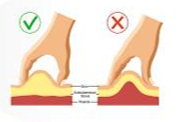
Photo source: https://pmc.ncbi.nlm.nih.gov/articles/PMC10570228/#CR12
Rotate Your Injection Sites
Having multiple injection sites makes for happier and healthier tissue. Areas you can use for injection are the backs of the upper arms, abdomen, hips, upper outer part of the buttocks, and thighs. You’ll want to make sure you’re staying at least 2 inches from any bones or joints and 2 inches away from the belly button. It’s recommended that each injection be at least 1cm away from the previous injection. (And since you’re not whipping out a ruler at injection time, that’s about one finger width.) Rotating injection sites gives your tissue time to rest and heal between injections, helps insulin absorb, and prevents lipohypertrophy (more on this below!).
Some people rotate by visualizing a clock and going around the clock at each injection site. For others it’s more helpful to imagine a grid pattern. Then you either go around the clock or through the grid at each site. Or if you’re like me and can’t remember that from day to day, you can put a note in your phone with a list or picture of sites and check them off as you go until it becomes a habit. The more sites on your body you can use and the more you can rotate within those sites, the better your insulin will continue to work.
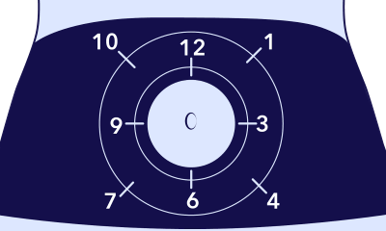
Source: https://pmc.ncbi.nlm.nih.gov/articles/PMC6640874/
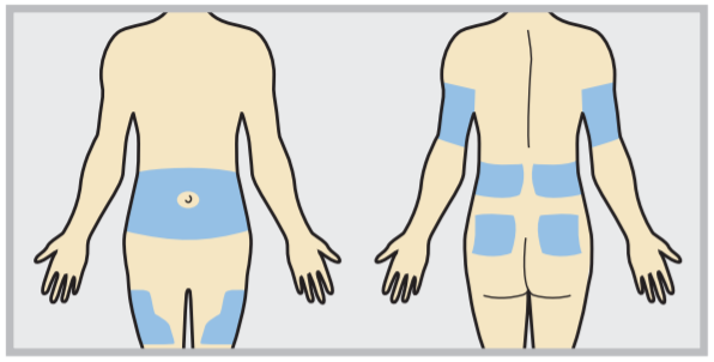
Photos from: https://www.medtronicdiabetes.com/loop-blog/lumps-and-bumps-from-insulin-therapy
What the Heck is Lipohypertrophy
Do you have a favorite injection or pump site because it just doesn’t hurt like other sites? If you said yes, I have some bad news for you. The reason that site doesn’t hurt could be lipohypertrophy.
Lipohypertrophy or LH is caused by injecting or infusing insulin into the same area over and over again. This makes the fat tissue in that area increase in size and grow too fast. This tissue is no longer able to absorb insulin correctly and can cause high and low blood sugars, higher A1cs, and even DKA. One study even showed that patients administering insulin into lipohypertrophied tissue used up to 10 units more insulin per day than people without LH. This is because the insulin was not absorbing correctly into the damaged tissue! Source: https://pubmed.ncbi.nlm.nih.gov/27594186/
Another study showed A1c with 0.55% higher in patients with LH than in patients without it. https://pubmed.ncbi.nlm.nih.gov/27594186/
Tissue with lipohypertrophy can be described as lumpy, spongy, rubbery, hardened, swollen, or nodular. Lipoatrophy is different from lipohypertrophy, it is rare. This is the loss of fat tissue. Areas with lipoatrophy can look dimpled or sunken. But there is good news! If given a break from injections by using other sites, LH can usually heal. This can take weeks, months or even years to heal depending on the severity. Using a new needle each time, using the shortest available needles and rotating injection sites are all ways to prevent lipohypertrophy and lipoatrophy.
If you think you might have areas of lipohypertrophy or lipoatrophy, talk to your endo team about your concerns. They can also give you guidance about additional sites to use and how long to avoid LH areas.
Tell Me the Good News
You can reach your diabetes goals using insulin injections! Everyone should know how to give a proper injection. If you’re on a pump and take a pump vacation or have a pump failure, you will likely need to revert back to injections. By using best practices for injection techniques, you’re way less likely to have lipohypertrophy and your insulin will work better! As always, check out the resource hub and our socials for more info on insulin injections.
All Sources:
- https://pmc.ncbi.nlm.nih.gov/articles/PMC10570228/
- https://www.adces.org/docs/default-source/handouts/insulinrelated/handout_pwd_ir_protipstricks.pdf?sfvrsn=e3356359_21
- https://pmc.ncbi.nlm.nih.gov/articles/PMC6640874/
- https://pmc.ncbi.nlm.nih.gov/articles/PMC10658672/
- https://go.bd.com/rs/565-YXD-236/images/Patient%20Teaching%20guide.pdf
- https://pubmed.ncbi.nlm.nih.gov/27594186/
- https://pmc.ncbi.nlm.nih.gov/articles/PMC4876738/
- New injection recommendations for patients with diabetes – PubMed