
Editor’s note: Want to learn more about...
Whether we’re talking about medications like GLP-1s or SGLT2s, or other non-insulin therapies like using a CGM, there’s a lot to navigate within the system. Between insurance, talking with your Endo office, and pharmacies…this guide will break it all down for you, step-by- step to get you the information you need!
- Step 1: Look into insurance coverage
- Step 2: Discuss with your healthcare team
- Step 3: What’s next?
- Step 4: Help with payment
Insurance
Often insurances won’t cover these therapies without significant data from the doctor’s office. The best place to start is by calling the customer service number on the back of your insurance card (we know calling is scary, that’s why there’s a script below).
Call to inquire about:
- what brand of medication is covered
- what are the criteria for coverage
- are there any medications that need to be tried first
- where the medication may need to be filled.
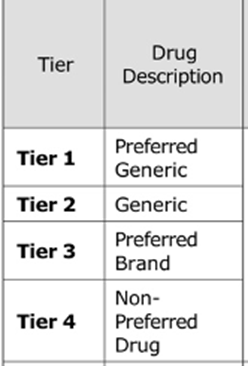
Some insurances make their list of covered medications, called a formulary, available online and you can see each medication and if it requires a PA. You can find your insurance formulary on your insurance website or portal, look for website information on your insurance card. On the formulary, drugs can be put into tiers (Figure 1), which can give you an idea of the least expensive and most likely to be covered medications.
Figure 1.
An online formulary may look something like this (Figure 2). You can generally search for the medication by name, and it will tell you the drug tier and if it requires something called a Prior Authorization or “PA”. A PA is when your doctor has to get special approval from the insurance company before paying for a medication. It’s extra paperwork to explain why the medication is needed and the insurance company will respond to the request.
Figure 2.


On this formulary, only Ozempic (semaglutide) and Mounjaro (tirzepatide) were present, other medications like Wegovy (semaglutide) and Victoza (liraglutide) were not listed which means that they likely aren’t covered. You can see that both Mounjaro and Ozempic here are tier 3 and require a PA. This helps you narrow down the medications that are more likely to be covered but you still need more information!
Having as much information as possible before you even talk to your endo team will be very helpful in guiding treatment. You may also have separate pharmacy coverage, in which case you might have to chat with your pharmacy benefit manager (PBM) about that coverage. For example, Blue Cross may have Express Scripts as a PBM. In that case, you may need to call Express Scripts. Other common PBMs are CVS Caremark and OptumRx.
Script for calling insurance companies/PBMs:
“Hello, I’m calling with some questions about medication coverage. Specifically looking for coverage of ______________ (drug name) or other ______________ (drug type) under my plan.”
They will ask for your plan information on your card as well as information to identify you, like your name and birthday. Have your insurance card handy when you call so you have all the numbers you need. Often the insurance company may say something like “it’s covered with a PA.” That’s when you ask the criteria that need to be met within the PA. This part is very important for getting a medication approved by the doctor’s office. Then ask if there are any restrictions with where the medication needs to be filled. Meaning is there a specific pharmacy; does it need to be mail order or can you pick it up at your local pharmacy etc.
Take good notes and bring those with you to your next doctor appointment!
Talking to Your Doctor
You now have the information about what coverage may look like with your insurance and where the script needs to be sent. Now let’s prep for your endo office visit. It’s usually best to discuss this in an appointment, rather than over the phone or electronically, so you can talk with your provider directly and in person. Come prepared and willing to help.
If your doctor recommended you start on a med, then you already have the info you need! If the script is sent in and there are coverage issues, you can go back to the insurance coverage section for help.
Be direct and curious when talking to your doctor!
Script for talking to your doctor:
I wanted to talk to you about starting on ____________ (medication/therapy).First, here’s why I think I could benefit from the medication:
- Are concerned about insulin resistance
- Want to spend more time in range
- Want help lowering A1c
I called my insurance, and this is the information I found out. This will need a Prior Authorization and here’s the criteria that needs to be listed in the PA.
I also know that it needs to be sent to the following pharmacy.
Lastly, I can offer to write a patient letter to the insurance company to be included in the prior authorization.
What’s Next
Hopefully all this work you’ve put in leads to you getting your new medication with no problem! But patience is necessary. The process for some of these therapies can take time, especially with PAs. Insurance companies can take weeks to respond to PAs and appeals.
Now, it may happen where you’ve done all the research and come with all the information from the insurance company and in talking with your endo team, you don’t meet the criteria based on a certain measure. If the doctor is still willing to try and prescribe it, and it’s denied by the insurance company, you can still write a patient appeal letter once you receive notice of the denial. Or maybe you seemingly do meet all the criteria but are still denied. The denial paperwork will be sent to you and your doctor, and it will have information on how to complete an appeal. If this is something you try, make sure to include the denial information, your plan information as well as your name and date of birth. Make sure you specifically address the reason for denial in your letter. Your doctor may also complete an appeal on your behalf.
Another quick note, if someone other than your endo team is prescribing this therapy, your endo team still needs to know you are taking it. If it’s a medication, you may need adjustments to your diabetes management and other medications, especially insulin.
Other resources for payment
The thing about these therapies is that they’re quite expensive if not covered by insurance. Most drug companies have resources for savings cards. These are usually not applicable to patients using Medicaid or Medicare, but only for patients with commercial insurance. It’s helpful to look up the brand name that’s covered under your insurance and “savings card”. They will list the eligibility criteria and the possible out of pocket cost per month.
There are other online savings places to check as well, such as GoodRx. GoodRx coupons cannot be combined with your insurance coverage, meaning that you can either use your insurance coverage OR the GoodRx coupon but not both.
Conclusion
Navigating the process between insurance, your doctor’s office, and the cost of non-insulin therapies can be a whole lot to coordinate, and it may not be as easy as 1,2,3. Maybe you’re bringing the idea of medications to your doctor, or your care team brings up how using a CGM could benefit your diabetes management. Things may not go in order and, a lot like managing diabetes, this process may not be picture perfect. You have the tools you need and support on your side to make it happen. Go shoot your shot! (get it?)
“Navigating the process between insurance, your doctor’s office, and the cost of non-insulin medication can be a whole lot to coordinate, and it may not be as easy as 1,2,3.”