
Glucagon Series Sponsored by Xeris...
In my experience as a diabetes care and education specialist and someone living with diabetes for 27 years, I’ve seen A LOT of changes in the diabetes space. Especially when it comes to the variety of insulin pens available in the United States. Young adults managing diabetes with multiple daily injections (MDI) can particularly benefit from these innovations. Understanding the available options is essential for creating an effective treatment plan. This article explores concentrated insulins, like concentrated long acting insulins, U-200 Humalog, and U-500 Humulin R. We will also look at half-unit options like the Humalog Jr. Pen and the innovative Medtronic InPen. Here’s how these choices can fit into your diabetes care and how to communicate them with your doctor.
Understanding Concentrated Insulins
First, let’s take a look at concentrated insulins. These are intended for individuals who need higher doses (can someone say puberty and pregnancy hormones?) or have higher insulin requirements that standard formulations do not meet.
- A typical insulin pen contains U-100 insulin. This means it has 100 units of insulin per milliliter.
- 5 units of U-100 insulin would be a volume of 0.05 mL (this is about the size of a water droplet from your faucet)
- Toujeo, for example, is a long-acting insulin with a concentration of U-300. That means it contains 300 units of insulin per milliliter
- 5 units of U-300 inulin is 0.0167 mL (that’s about ⅓ of the water droplet!)
Remember – there isn’t less insulin, just less volume of liquid. We’ll get into why that’s important in the next section. One of the main advantages of using concentrated insulins is their ability to provide higher doses in smaller volumes. This convenience can significantly reduce the number of injections necessary each day and improve the efficacy of the insulin. For instance, a person using U-500 Humulin R might have to inject only twice a day instead of four or more times if using a standard formulation. For young adults dealing with insulin resistance, concentrated insulins can offer both comfort and flexibility.
Why Use Concentrated Insulin
Insulin absorption isn’t just about what you inject—it’s also about where, how, and how much. The location of your injection, the health of your skin, and the volume of insulin you’re using all impact how well it works. Let’s talk about volume—because size really does matter when it comes to insulin.
Think of injecting insulin like pouring water onto dry soil. A small puddle gets absorbed quickly, while a large flood (because you got a little trigger happy with the watering can) takes longer to soak in. That’s exactly what happens under your skin—bigger insulin doses create larger “pools” (depots) that slow down how insulin moves into your bloodstream, leading to unpredictable absorption.2
What This Means for Your Blood Sugar
- Unpredictable Insulin Action – The larger the dose, the more variability in how fast or slow the insulin works.
- Higher Risk of Highs & Lows – If insulin suddenly absorbs all at once, it can cause a blood sugar crash (hypoglycemia). If it lags too much, your blood sugar stays high (hyperglycemia) after meals.2
If you’re injecting more than 50 units of U-100 insulin at a time, clinical guidelines recommend splitting the dose into two different injection sites.3 That’s one option—but let’s be real, who actually wants to inject twice?
Enter concentrated insulin! These formulations pack more insulin into a smaller volume, so you can inject larger doses at a single site without worrying about erratic absorption.
To summarize, concentrated insulins…
- Help increase the efficacy of the insulin when injecting >50 units at a time
- Relieve some of the discomfort associated with injecting larger volumes of insulin
- Let’s your pens last longer so you’re not having to keep as many on hand (your butter compartment is only so large)
And a VERY important thing to keep in mind here: there is NOTHING wrong with injecting larger volumes of insulin. If this is what your body needs, it’s what your body needs. And you deserve to have the tools that manage your blood sugars safely and with a little less frustration.
Exploring Concentrated Insulins
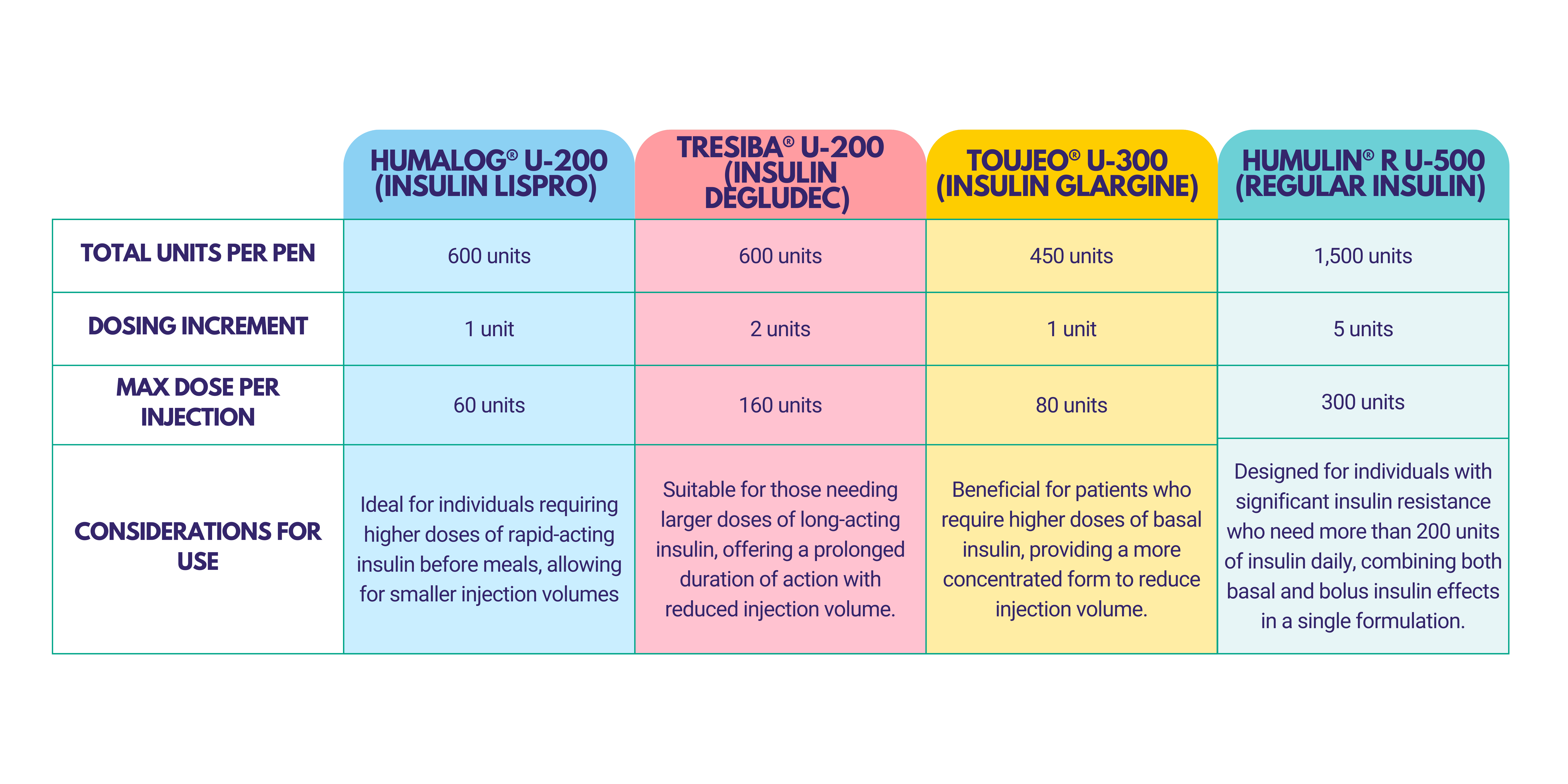
Here’s a list of concentrated insulins currently on the US market, how many units are contained in each pen, the increment of dosing, max dose possible in one injection, and some other things to consider.
Benefits of Half Unit Increment Pens
For many, accurate dosing is a critical factor in managing diabetes. Half-unit pens, like the Humalog Jr. Pen, enable more precise insulin delivery, making them ideal for those who require smaller doses. This feature is especially beneficial for individuals trying to align insulin with carb intake. For example, if Alex is getting ready to eat a Chipotle Bowl containing 45 grams of carbs and uses an insulin to carb ratio of 1:18, the ideal dose is 2.5 units. Using a standard pen, they have to decide if they want to go for 3 units and possibly go low or 2 units and maybe not have enough insulin to cover the food.
The Humalog Jr. Pen caters specifically to those who need doses of less than a full unit. By allowing for these smaller increments, users can achieve greater stability in blood sugars, leading to fewer fluctuations throughout the day. Another pen that offers half unit increments is the Medtronic InPen – but this pen is also a smart pen (cue the ooo’s and ahhhh’s).
The InPen
Another option for half unit increments is the Medtronic InPen. This pen offers way more than just the half unit increments though. It also tracks insulin delivery and helps users log doses and set reminders for future injections. For active young adults (or pretty much anyone) living busy lives, this functionality is invaluable. By maintaining accurate dosing, users can better manage their diabetes. The InPen also allows users to calculate doses using different methods like the standard insulin to carb ratio, small-usual-more dosing, and fixed/time based dosing.
The InPen can also sync with smartphone apps and CGM data, offering insights into blood glucose trends. For instance, if blood sugar rises occur after specific meals, users can analyze their insulin response and make educated adjustments. The InPen app even lets you fax or email reports straight to your doctor for review. This level of monitoring can lead to improved overall management.
Conversations with Your Doctor
When discussing your insulin options with your healthcare provider, consider preparing a list of focused questions. Here are some essential points to cover:
- Current Management Plan: Clearly outline your existing regimen and any challenges you face. If you experience frustration with fluctuating blood sugar levels or dosage, communicate this.
- Doses >50 units: If you are giving doses larger than 50 units and/or having to split the doses, let your doctor know that you are interested in the concentrated insulin to minimize injections and improve absorption.
- Precision in Dosing: If you find that you are someone who could benefit from half unit dosing (lots of hypoglycemia or hyperglycemia that could be fixed by a half unit adjustment), ask your doctor if they would be open to prescribing a Humalog Jr. Pen or an InPen.
- Incorporating Technology: If the burden of calculating doses is getting in the way of taking injections consistently, ask your doctor if they would be open to prescribing an InPen or another smart pen.
By proactively bringing these topics to your appointment, you take charge of your diabetes management. This approach enables you to arrive at a personalized treatment plan tailored to your lifestyle and medical needs.
Embracing Modern Tools for Better Management
Living with diabetes as a young adult can be challenging. However, advancements in insulin and technology offer many ways to improve management and personalization of treatment. Concentrated insulins, half-unit options, and smart pens change how we approach diabetes management.
When considering these options, having open conversations with your healthcare provider is essential. Equip yourself with knowledge regarding your insulin needs and the available tools to help meet them. The right choices can lead to a substantial positive shift in how you manage your diabetes, enhancing your everyday life.
References
- American Diabetes Association. The nuances surrounding insulin prescribing. Clinical Diabetes. 2023;41(3):411-420. Available at: https://diabetesjournals.org/clinical/article/41/3/411/148661. Accessed February 14, 2025.
- Gradel AKJ, Porsgaard T, Lykkesfeldt J, et al. Factors Affecting the Absorption of Subcutaneously Administered Insulin: Effect on Variability. J Diabetes Res. 2018;2018:1205121. Published 2018 Jul 4. doi:10.1155/2018/1205121
- Mayfield JA, White RD. Insulin therapy for type 2 diabetes: rescue, augmentation, and replacement of beta-cell function [published correction appears in Am Fam Physician. 2004 Dec 1;70(11):2079-80]. Am Fam Physician. 2004;70(3):489-500.
- Novo Nordisk. Tresiba dosing and administration guide. Tresiba.com. Available at: https://www.tresiba.com/how-to-take-tresiba/tresiba-dosing.html. Accessed February 14, 2025.
- Sanofi. Toujeo prescribing information. Toujeo.com. Available at: https://www.toujeo.com. Accessed February 14, 2025.
U.S. National Library of Medicine. Humulin R U-500 insulin: prescribing and safety information. Drugs and Lactation Database (LactMed). Available at: https://www.insulins.lilly.com/humulin. Accessed February 14, 2025.